


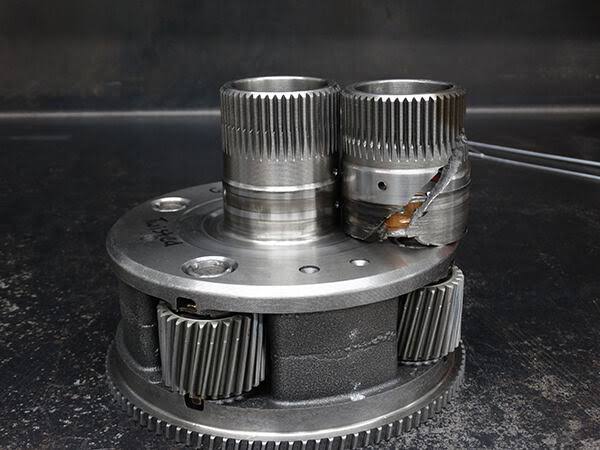
Most diesel owners whose transmissions failed them after tuning like to blame the transmissions themselves. The truth, however, is that it was the tune all along, specifically what it took away. Torque management is factory for a reason, and that level of understanding and restraint is what allows a 150,000 mile build to occur versus a $6,000 rebuild before the end of the tune warranty.
The factory is not being cheap, it is being safe
New diesel trucks are being built with restricted torque capacities. This is not done to stifle performance and/or towing potential, it is actually a safety measure. The weakest link in any drive train is the transmission, and this is especially true in this Dodge Ram 2500 6.7 Cummins + Chrysler 68RFE setup. The engine is physically capable of producing substantially more torque than is allowed by the factory, but the transmission is not reliable enough to handle such a load over the span of 100,000+ miles of towing. The reason for this is the factory TCM (Transmission Control Module), a separate computer that controls when/where/how your transmission will shift, line pressure, and what torque capacity limits are for each gear. The TCM limits torque in lower gears in order to protect your transmission from torque spikes that exceed the capability of your torque converter. The other reason for this is emissions, because the torque limitation tables serve a dual purpose of reducing soot production, which in turn reduces the frequency and volume of DPF regeneration cycles. By removing the torque limit with a custom tune, you remove this emissions control device, which is why it is so vital that diesel owners in particular research the emissions regulations in their region.
The torque converter always fails first, here is why
Ask any transmission shop that deals with performance diesels about the most common point of failure in a transmission that has been tuned, and they will tell you the same thing. The gear set almost never fails first. It is always the torque converter clutch (TCC).
This happens because a diesel engine’s torque curve peaks at an absurdly low RPM range (usually between 1500-2000 RPM), which coincides with the torque converter’s weakest point of engagement, the beginning of the slip range. What this means is that, when you add 100+ lb-ft of torque to the rear wheels via a custom tune, you are adding that much extra torque to the torque converter clutch at the worst possible time and place, when it is most likely to slip. The extra torque causes extra heat to be generated at the TCC, which in turn cooks the friction material on the clutch discs and causes the automatic transmission fluid to prematurely break down and lose viscosity at the worst possible time; when the torque converter clutch is needed most. The next time the clutch engages, it will blister the linings even more than the previous time, and so on and so forth. This is not necessarily a sudden, catastrophic failure; it is a compounding failure that can occur over hundreds, or even thousands of miles.
The 68RFE is the most notorious example of a torque converter limited transmission, but even the higher capacity Aisin AS69RC behind the Ram 3500’s high output 6.7 Cummins is prone to the same issues when pushed beyond its limits.
Heat is the silent killer of any automatic transmission, and a fluid temperature gauge is mandatory on any tuned diesel
Fluid temperature is by far the most important determinant of the health of an automatic transmission which is under load, and most factory dashboards do not have one. Transmission fluid temperature is why the industry standard fluid change interval is cut in half for every 20 degrees Fahrenheit above 175 degrees that the fluid is run. A tuned diesel will often see temperatures in excess of 220 degrees, which shortens the interval by 4x, and 240 degree fluid temperatures are downright ludicrous and exponentially degrade the fluid. A temperature gauge is a must-have on any tuned diesel, period. You need to actually know what is going on inside the transmission in order to make educated decisions about how/when you should change the fluid, how much you can safely tow, and whether or not the modifications you have made are sustainable.
Factory recommended fluid change intervals for automatic transmissions are usually around the 60,000 mile range, assuming mostly highway driving with some towing mixed in. That number should be cut in half for a tuned diesel that regularly sees towing duties. Synthetic fluid is generally recommended for such applications, but it is not a cure-all for thermal degradation.
Why most owners are completely wrong about model year differences
This is a point that many forums overlook, and many owners fall victim to expensive mistakes because of it.
Transmission hardware, and even TCM programming, can differ drastically between model years. Some differences are made in response to warranty claims, others are made in response to engineering tweaks, and others still are the result of completely different platforms sharing the same transmission. RAM utilizes both 68RFEs and Aisin AS69RCs across its model year range, and the 6.7L Cummins’ torque curves can differ drastically from one model year to the next. Ford utilizes both 6R140s and 10R140 TorqShifts in its Super Duty platform, and the newer 2020+ TorqShifts were engineered around the 6.7 Power Stroke’s torque curve, and will behave completely differently from a 2018 F-350’s 6R140.
In short, what works for your brother’s 2018 Ram 2500 may very well not work for your 2022 Ram 2500 that is due for a tune. The logic behind shift scheduling, converter lockup, and line pressure management will change drastically from model year to model year. Some TCMs even receive updated programming with the same model year, so the part number on the back of your brother’s 2019 Ram 2500 may be completely different from the one on your 2022 Ram 2500, and a tune that worked great on his may very well be detrimental to yours.
This is why it is so important that, when shopping around, you look at options such as 6.7 Cummins tuner, RaceME Official and ask about year specific calibrations that are tailored to your specific ECM and TCM part numbers. A file that only works on 2018 Rams is not going to be very helpful to a 2022 Ram owner, and an aggressive power file that ignores the model year differences can be downright dangerous. There is nothing wrong with a universal power file, it’s just that most owners do not realize that a truly comprehensive calibration should take all of these differences into account.
The Allison 1000/2000 series in the GM Duramaxs, while generally reliable, operate on the same principles in terms of shift scheduling and fluid temperatures, so they are no exception to this rule.
What makes up a transmission-safe tune?
Adding extra fuel is the easy part of a diesel tune, and nearly any file will do it. It is what the file does to raise line pressure (which causes clutch packs to apply harder), cause the torque converter clutch to lock up earlier, and schedule shifts to occur later in the power band that determines whether or not the tune is safe for the transmission.
Failure to raise line pressure in line with the increase in fuel will cause clutch packs to slip at higher torque loads than they would otherwise, which causes them to get hot and break down faster. Increasing line pressure and shift firmness will cause the clutch packs to engage harder, reducing slippage and the subsequent heat generation. Commanding the torque converter clutch to engage at a higher percentage of torque output will cause the torque converter to slip less than it otherwise would, and the reduction in slippage reduces the amount of heat generated at the clutch surfaces.
Shifting schedules need to be adjusted as well, because an engine with a broader, flatter torque curve that sees the majority of its power produced at a higher RPM will suffer from excessive revving if the transmission shifts too early, especially in higher gears. In such a case, the torque curve needs to be taken into account when the tune shifts, or the torque converter will stay in the slip range too long and the clutch packs will suffer. It is not enough to simply increase power and move on; the shift points need to be raised so that they coincide with the increased power, otherwise the transmission suffers.
A proper tune will allow most of the low gear torque management to remain in place. It will not blindly delete it to make power, it will raise the shift points to match the new power curve, and reduce the risk of the transmission suffering.
Upgrades that make a difference
Tuning alone can get you to a safe point in terms of power, but the more power you make the more risk you take on the stock transmission. An aftermarket torque converter with a reinforced clutch pack and a stronger lockup mechanism is the absolute best upgrade you can make to a high power build, because it directly addresses the weakest link in the drive train, the torque converter clutch. It is the torque converter that is slipping and generating heat on a stock converter, and an aftermarket converter can reduce that risk substantially.
An aftermarket valve body allows the transmission to shift faster and with more aggression than stock, which reduces the amount of time the clutches are slipping between shifts, reducing the amount of heat they are exposed to over the life of the transmission.
A proper tune with a supporting converter and valve body is not the same thing as a stock transmission with an aggressive tune, and the two are not equivalent options. The tune that is used needs to raise line pressures and shift points in order to reduce the amount of heat that is generated, and a good valve body helps it do exactly that.
Knowing the torque capacity of your transmission
Before you install any tune, you need to know the torque capacity of your transmission. Not your engine, your transmission. For reference, most 68RFEs are limited to about 620 ft-lbs of torque, and the Aisin AS69RC is much higher. The brand new 10R140 is actually capable of handling the full torque potential of the 6.7 Power Stroke. These are completely different transmissions, and they behave completely differently under wide open throttle.
Pushing several hundred ft-lbs of torque through a transmission that is only rated to handle a fraction of that will always result in premature failure, but it is not always catastrophic. It will often result in a rebuild at 15,000 miles instead of a 100,000 mile rebuild. The difference between the two scenarios is often a combination of three things; how much the tune exceeded the torque capacity of the transmission, what model year of transmission the owner had, and whether or not the owner was aware of and/or respected the importance of transmission fluid temperature and fluid change intervals.
The decision framework before you tune
Install a fluid temperature gauge first, and learn about your transmission’s torque capacity. Ask the tuner you are considering if they offer model year specific calibrations for your vehicle, and whether or not the file you are considering actually modifies line pressure and shift firmness. Schedule fluid changes at 30,000 mile intervals instead of the factory recommended 60,000. Budget for an aftermarket torque converter if your tune exceeds the factory torque capacity of your transmission.
